How we compare
Knowledge graphs that learn.
Neo4j is a powerful graph database. But a database that doesn't update itself is a database that decays. Oiya keeps your knowledge graph alive.
Traditional knowledge graphs
Manually modelled by knowledge engineers. Updated in batches after the business has already changed. Powerful schema, brittle freshness.
Oiya
Self-learning from connected sources and agent activity. Updates are proposed continuously and reviewed before they become canonical, with versioning and rollback built in.
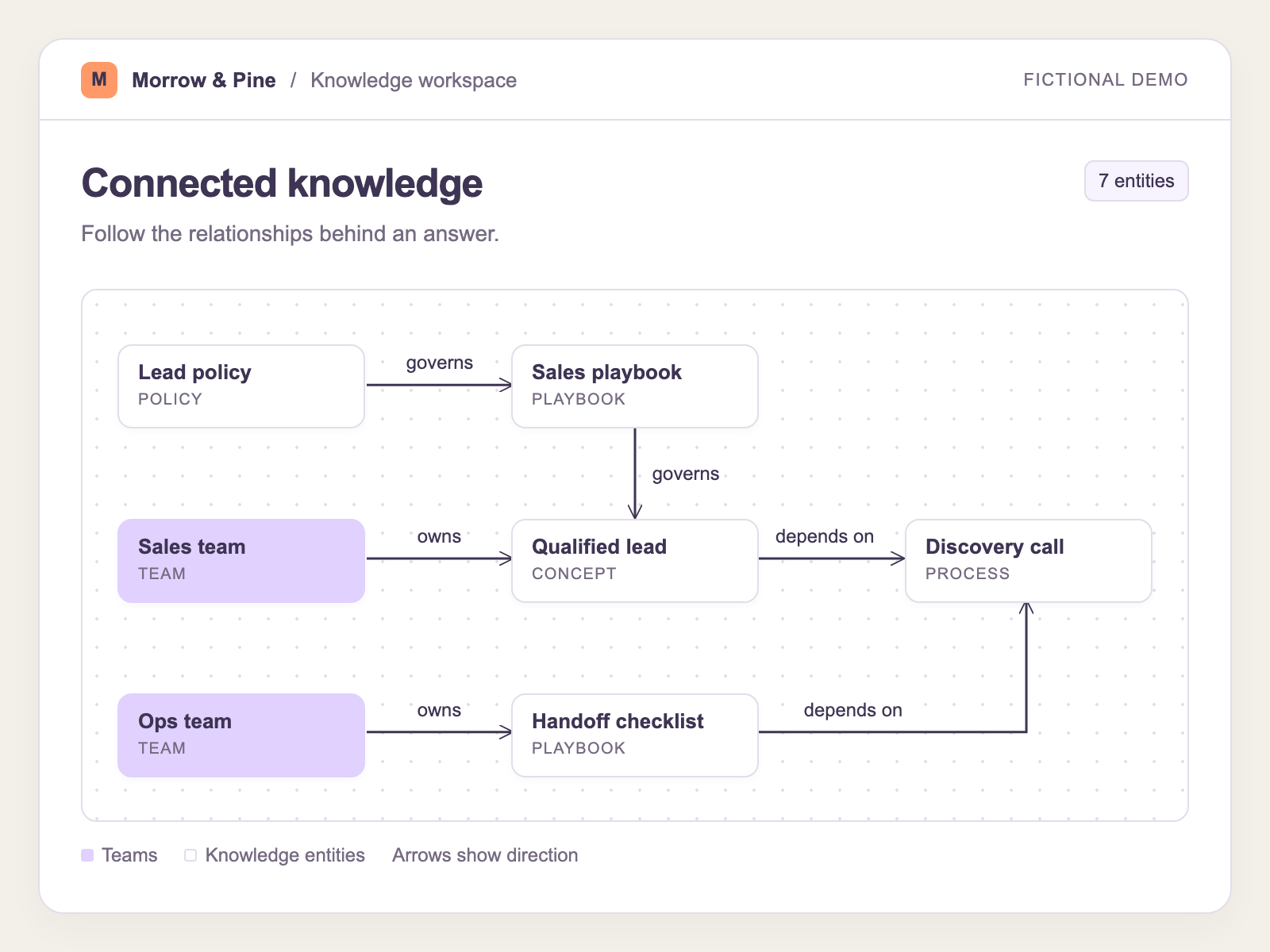
Knowledge graphs are useful because they model relationships. The hard part is keeping that graph current, governed and usable by agents without turning it into another system your team has to operate. Oiya gives agents graph-structured company knowledge, learned from live sources and reviewed before it becomes canonical, without asking your team to run a graph database. It is built for AI agents rather than human analysts.
Knowledge graphs vs Oiya, at a glance
How it's built
Knowledge graphs (e.g. Neo4j)
Oiya
How it stays current
Knowledge graphs (e.g. Neo4j)
Oiya
Governance
Knowledge graphs (e.g. Neo4j)
Oiya
Agent access
Knowledge graphs (e.g. Neo4j)
Oiya
Operational overhead
Knowledge graphs (e.g. Neo4j)
Oiya
Primary use case
Knowledge graphs (e.g. Neo4j)
Oiya
Neo4j is powerful. But static.
Neo4j gives you Cypher queries, graph traversals, and relationship modelling that vector databases can only dream of. If you're building fraud detection or recommendation engines with well-defined, slowly changing data, it's an excellent choice.
But here's the reality of company knowledge: it changes constantly. Acme Corp restructures their sales territories. Your compliance team updates the CR Policy to v2. A new competitor enters the market. In a static Neo4j graph, none of this happens until a knowledge engineer manually updates every affected node and relationship. And by then, your agents have been working with stale data for weeks.
Building a knowledge graph is the easy part. Keeping it alive is where most teams fail. That's the problem Oiya solves.
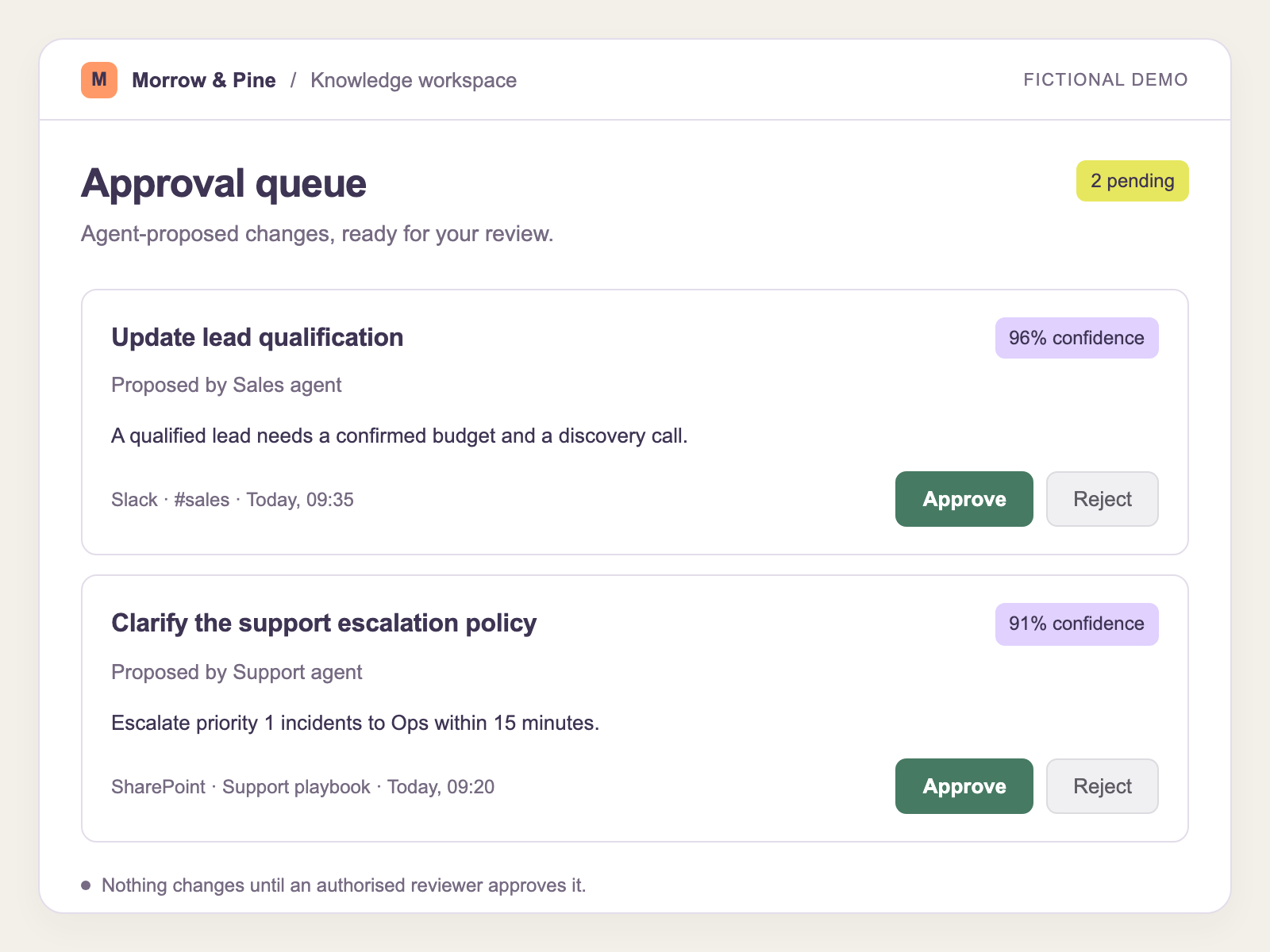
Agents propose. Humans approve. Knowledge evolves.
Oiya turns every agent interaction into a learning opportunity. A support call reveals new terminology. A BD conversation surfaces a competitor acquisition. A meeting transcript captures a process change. Each of these becomes a structured proposal, scored for confidence, routed for review when sensitive, auto-approved when safe.
No knowledge engineers required. No batch re-imports. No hoping someone remembered to update the graph after last week's reorg.
Your graph doesn't decay. It grows.
Governance built in, not bolted on.
Neo4j is a database. It doesn't have opinions about who should approve a schema change or whether last Tuesday's update was a good idea. You'd need to build all of that yourself: versioning, rollback, audit trails, permission scoping.
Oiya ships with all of it. Every change is versioned. Proposals carry provenance: which source triggered them, which agent proposed them, when they were approved. You can compare states side by side and roll back when something goes wrong. It's not just a graph; it's an operating system for company knowledge.
Knowledge that remembers how it got here.
Bring your own graph.
Already running Neo4j? You don't have to rip it out. Oiya can sit on top of your existing graph infrastructure and add the governance, learning, and versioning layers you're missing. We'll help you structure the extraction pipeline and keep your graph in sync with reality.
Or use ours. Oiya ships with a built-in knowledge graph optimised for agent consumption: sub-100ms retrieval, partition-aware queries, and permission scoping out of the box.
Stop maintaining your graph by hand.
Let your agents do the learning. Keep humans in control.
For the wider picture, read what a company knowledge layer for AI agents is and why multi-agent systems need one.
More comparisons
vs RAG
RAG finds documents. Oiya understands your company.
vs Zep / Graphiti
From personal memory to company knowledge.
vs Mem0
Agent memory vs governed company knowledge.
vs Pinecone
Knowledge layer vs knowledge engine.
vs OpenAI Memory
Your knowledge. Your infrastructure.
Knowledge Management
See the full knowledge management platform.