How we compare
From personal memory to company knowledge.
Zep and Graphiti are great at giving a chatbot memory. Oiya gives every agent in your organisation a shared knowledge layer, with governance, versioning and multi-agent support built in.
Zep / Graphiti
Per-user, per-agent conversation memory. Each session remembers its own history, but nothing is shared across agents or the organisation.
Oiya
A shared, organisation-wide knowledge layer. Every agent reads from the same typed entities, definitions and policies, kept consistent by governance.
Zep and Graphiti provide per-agent memory. Oiya provides a shared knowledge layer across all agents in a business, governed, structured, and designed to prevent knowledge divergence between agents rather than just giving each agent its own recall.
Zep / Graphiti vs Oiya, at a glance
Memory scope
Zep / Graphiti
Oiya
What it stores
Zep / Graphiti
Oiya
Cross-agent sharing
Zep / Graphiti
Oiya
Governance
Zep / Graphiti
Oiya
Versioning & rollback
Zep / Graphiti
Oiya
Primary use case
Zep / Graphiti
Oiya
Great for chatbots. Not for companies.
Zep and Graphiti solve a real problem. They store conversation history, extract entities from chat sessions, and build temporal knowledge graphs that track how facts evolve over time. Zep achieves P95 retrieval latency of 300ms. The engineering is solid.
But they're designed for per-user memory. One user, one conversation thread, one graph. That's perfect if you're building a single chatbot that remembers what a customer said last Tuesday. It's not enough when you're deploying dozens of agents across multiple teams and need them all working from the same understanding of your business.
Zep tracks what a single user said across conversations. Oiya tracks what your company knows across all agents.
Multi-Agent Architecture
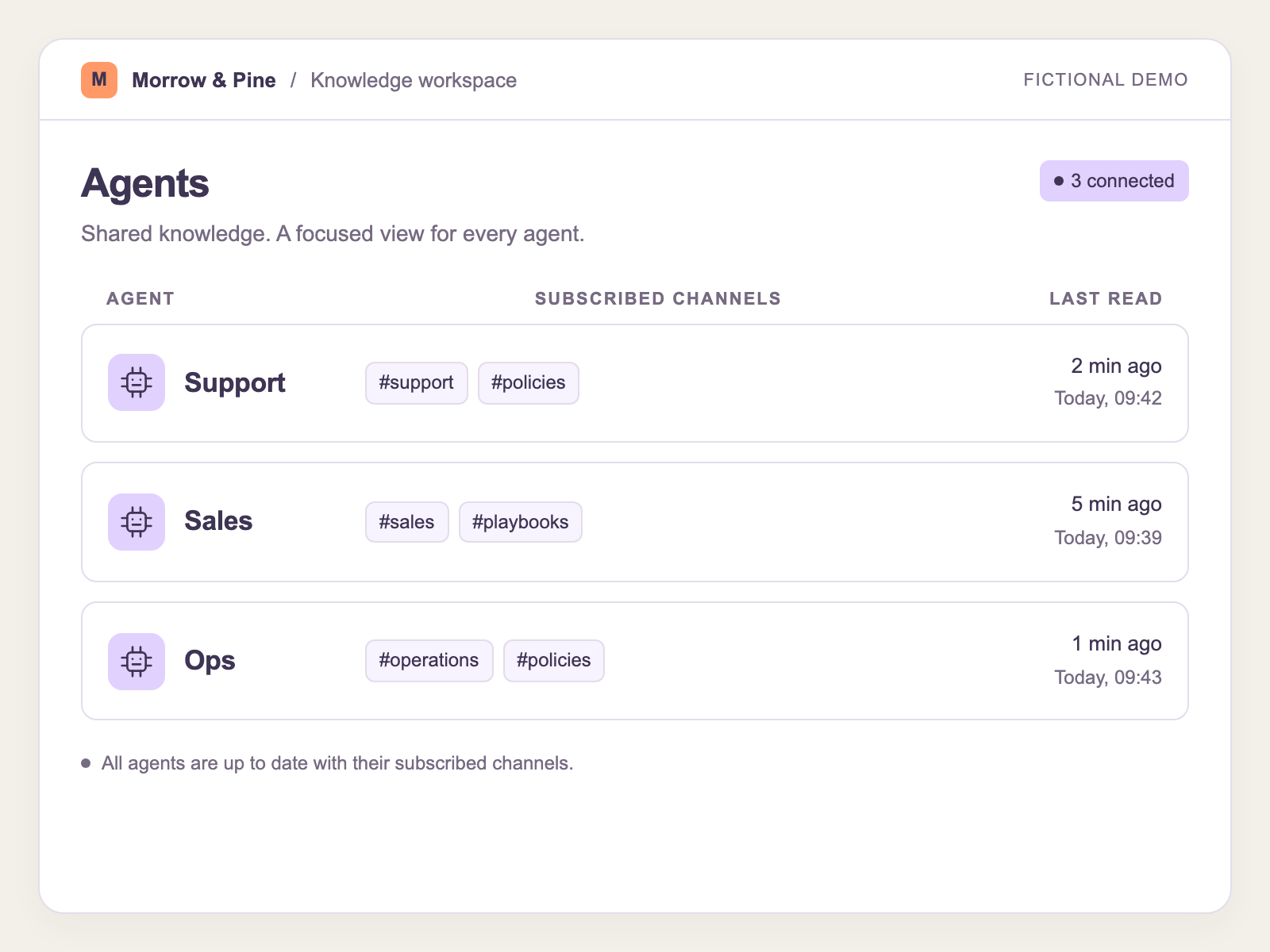
One agent learns, every agent knows
When your BD agent discovers that Acme Corp just hired a new CTO, that fact shouldn't live in one conversation thread. Your support agent needs it. Your onboarding agent needs it. Your account management agent definitely needs it.
Oiya makes knowledge a shared resource. Every agent connects to the same ontology, scoped to the partitions it needs. New facts flow through a proposal system: reviewed, approved, then available to every agent with access. No sync scripts, no duplicate graphs, no drift.
Your agents are a team. Their memory should be too.
Built for teams, not just threads
The gap between per-user memory and company knowledge infrastructure comes down to four things Zep wasn't designed to handle.
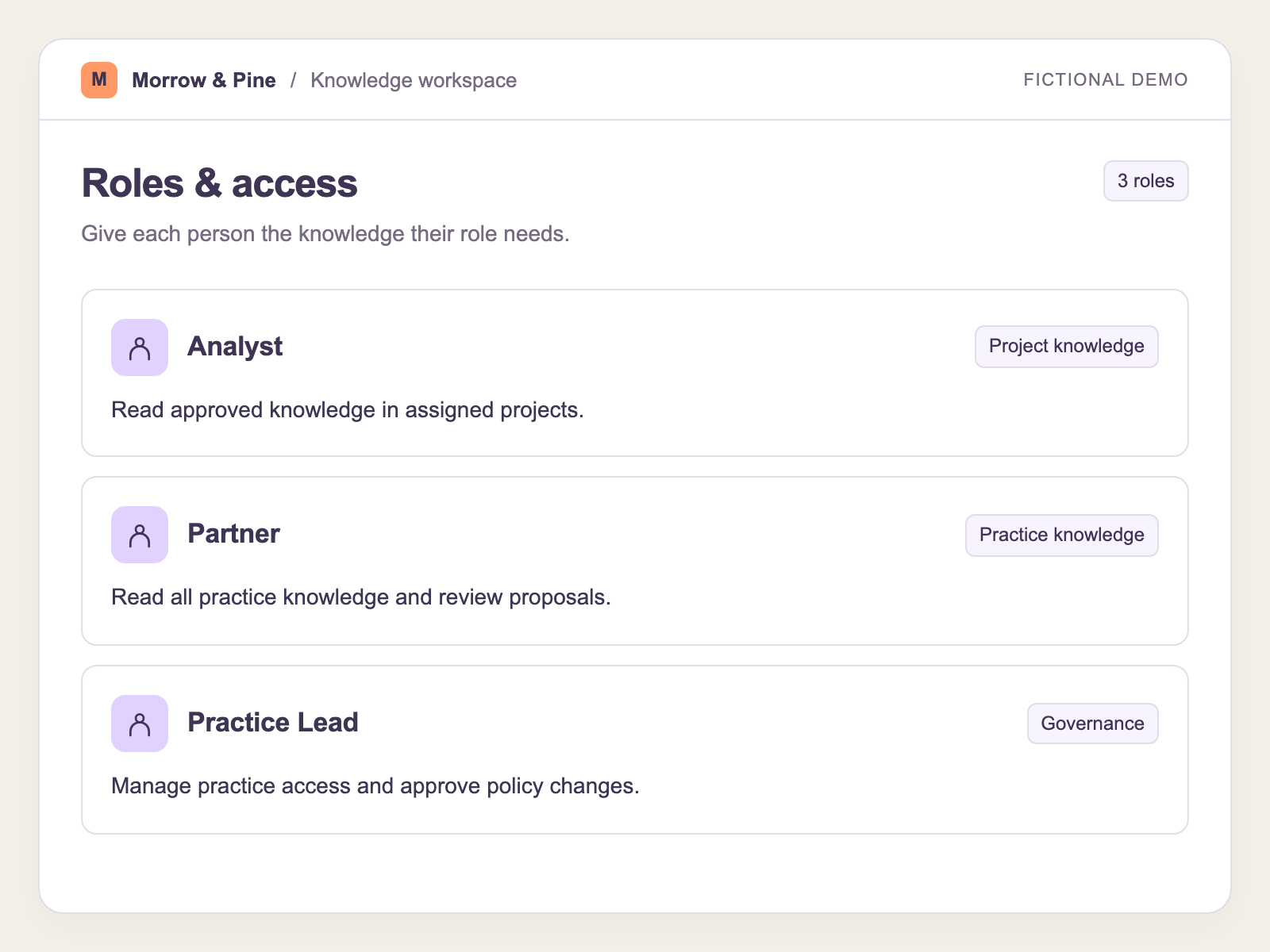
Governance
Changes go through a review process before they become shared knowledge. Proposals carry confidence scores. High-confidence, low-sensitivity updates auto-approve. Structural changes queue for human review. You set the thresholds.
Versioning
Every schema change, every entity edit, every approval is tracked. Roll back to any previous state when something breaks. Compare versions side by side. Full provenance for every fact your agents rely on.
Partitions
Scope knowledge by team, by client, by domain. Your healthcare practice sees healthcare entities. Your retail team sees retail. Core company knowledge lives in a shared partition everyone inherits. One schema, many views.
Multi-Agent
Every agent gets its own permission boundary and partition access. A BD agent can propose changes but not approve them. A support copilot gets read-only access. Knowledge flows between agents through the ontology, not through prompt engineering.
Governance
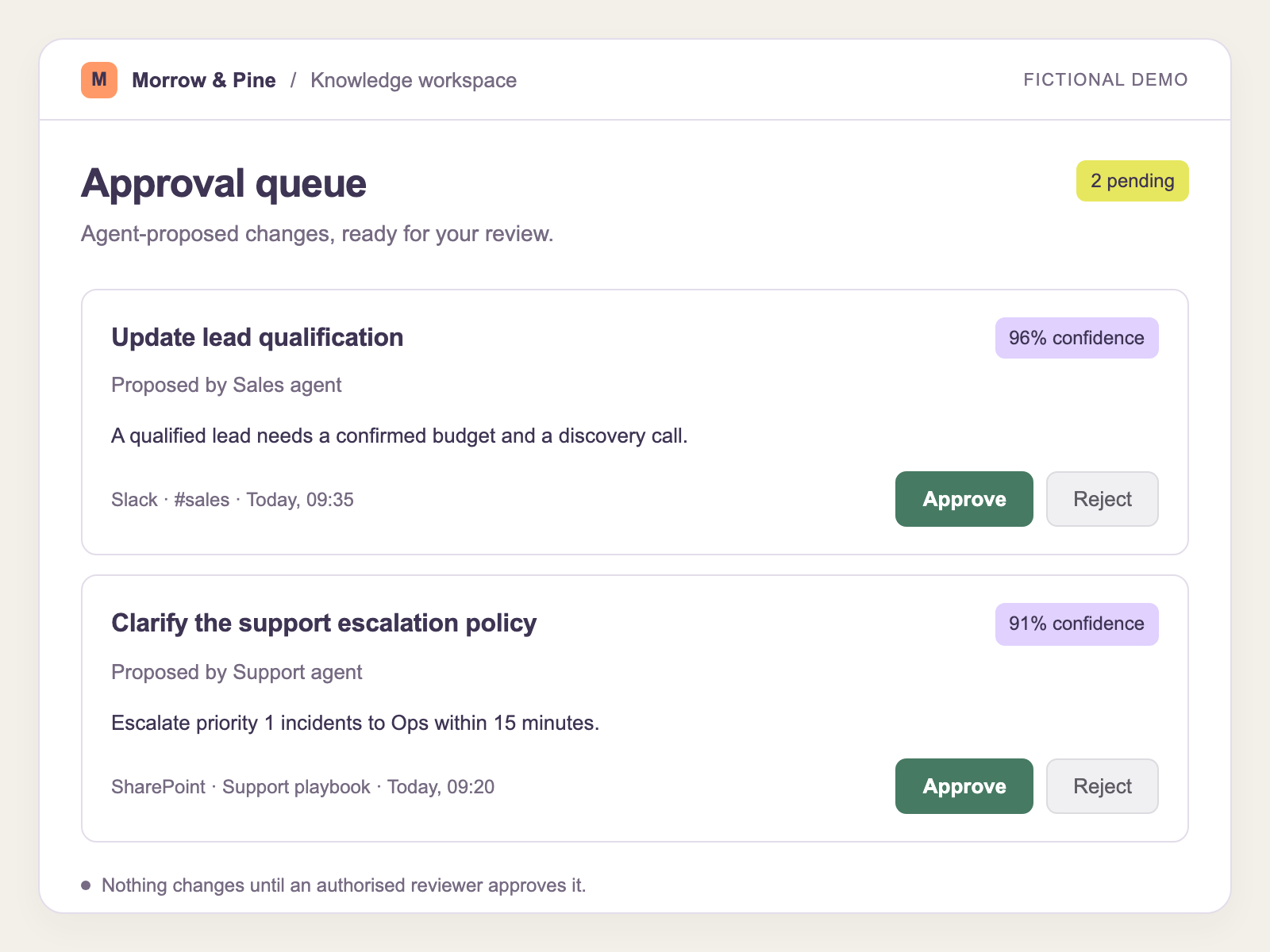
Knowledge your compliance team can trust
In a per-user memory system, there's no approval step. Facts go in and facts come out. That works for a personal assistant. It doesn't work when your agents are making decisions about clients, contracts, or regulated industries.
Oiya gives you role-based access at the partition level. Analysts get read access to core data. Practice leads get write access to their domain. Partners see everything. Agents follow the same rules. Permissions are structural, not prompt-based.
If you can't audit it, you can't trust it.
The right tool for the right job
If you're building a single chatbot with per-user memory, Zep is a solid choice. It does what it does well: fast retrieval, clean temporal graphs, good developer experience.
But if you're building agent infrastructure for a company, where multiple agents need shared context, where knowledge changes need review, where different teams need different views of the same ontology, you need something designed for that from the ground up.
Oiya isn't a better Zep. It's a different category.
Ready to move beyond per-user memory?
See how Oiya gives every agent in your stack shared knowledge with the governance and versioning your team needs.
For the wider picture, read what a company knowledge layer for AI agents is and why multi-agent systems need one.
More comparisons
vs RAG
RAG finds documents. Oiya understands your company.
vs Mem0
Agent memory vs governed company knowledge.
vs Per-agent memory
How Oiya sits alongside Mem0, Zep and Flumes.
vs Pinecone
Knowledge layer vs knowledge engine.
vs OpenAI Memory
Your knowledge. Your infrastructure.
vs Knowledge Bases
Built for agents, not humans browsing wikis.
Multiplayer memory
See how Oiya handles multiplayer memory.