How we compare
RAG finds documents. Oiya understands your company.
Retrieval-Augmented Generation is excellent at surfacing relevant text from document collections. But your agents need more than search results. They need structured understanding.
RAG / vector search
Returns the chunks most similar to a query. Each agent retrieves independently, with no shared definitions, no governance, and no memory of what changed.
Oiya
A structured, governed knowledge layer that every agent reads from. Typed entities, approved facts, provenance, and updates that flow through human review.
RAG (retrieval-augmented generation) retrieves relevant text chunks at query time. Oiya maintains a structured, evolving knowledge layer that captures terminology, relationships, processes and governance, context that chunk retrieval alone cannot enforce consistently across multiple agents.
RAG vs Oiya, at a glance
What it retrieves
RAG
Oiya
Consistency across agents
RAG
Oiya
Company terminology
RAG
Oiya
How it updates
RAG
Oiya
Provenance
RAG
Oiya
Primary use case
RAG
Oiya
RAG is great. But it's not enough.
RAG pipelines, whether you're using Pinecone, Weaviate, Chroma, or any vector store, do one thing well: they take a query, find semantically similar chunks of text, and pass them to an LLM. That's powerful for document search.
But here's what happens in practice. Your support agent asks "what does 'qualified' mean for enterprise deals?" and RAG returns three paragraphs from a sales playbook written eighteen months ago. Meanwhile, the enterprise team redefined "qualified" last quarter. Nobody updated the docs. The agent gives a confident, wrong answer.
Oiya solves a different problem entirely. It doesn't just find documents. It builds a structured model of your company. Terms have definitions. Processes have steps. People have roles. Relationships are explicit, not inferred from embedding similarity. And when something changes, agents propose updates that flow through governance before becoming shared knowledge.
Structure, not similarity
RAG retrieves text based on how close it is in vector space. Oiya retrieves knowledge based on what it actually means. Entities have types, definitions, and relationships. When your BD agent asks about Acme Corp's procurement process, it gets a structured answer, not a wall of text from a Confluence page that mentions "procurement" somewhere in paragraph four.
This is the difference between search and understanding. RAG gives you fragments. Oiya gives you facts.
Your agents deserve better than ctrl+F with extra steps.
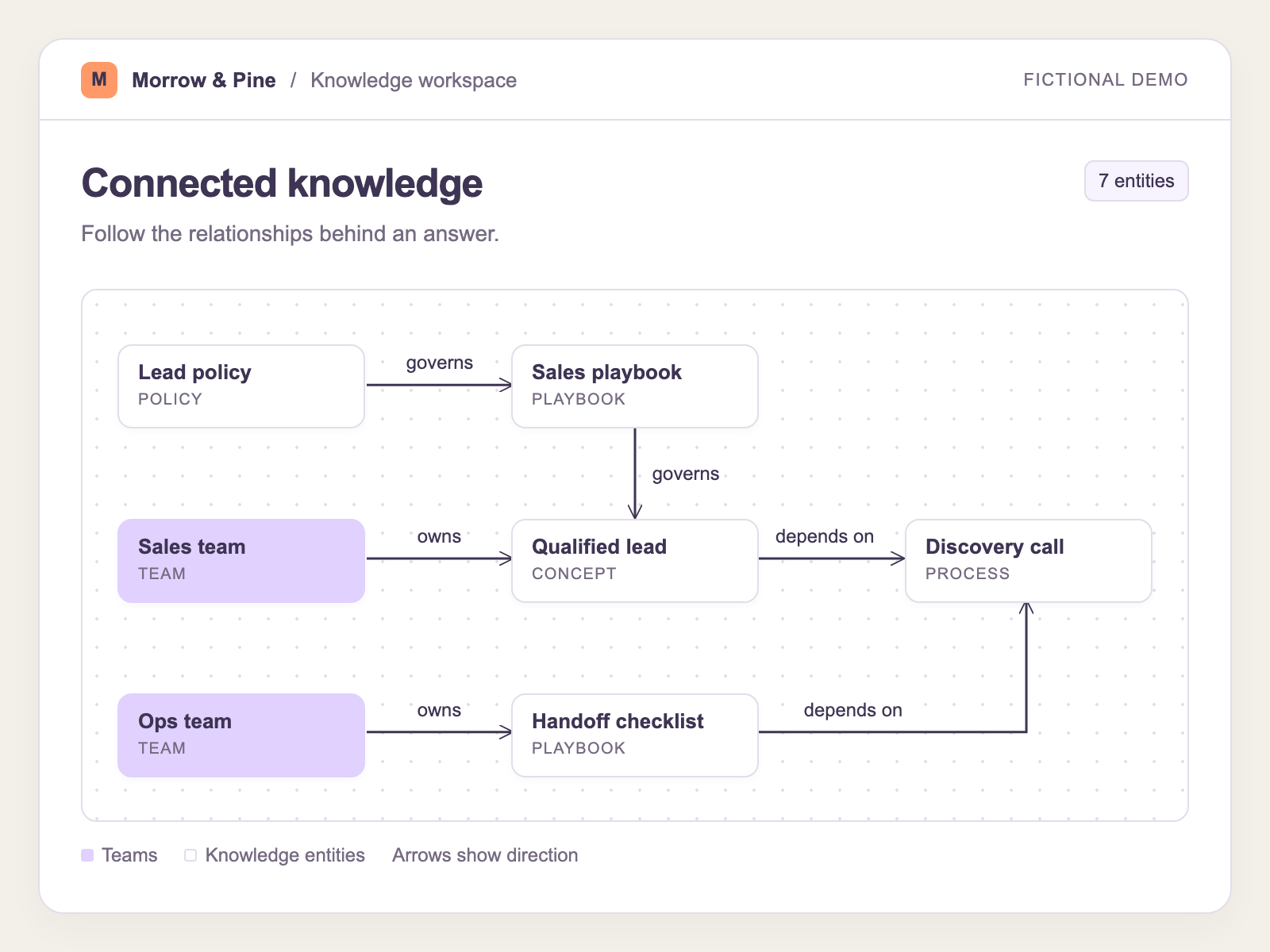
When to use what
They're not competitors. They solve different problems.
RAG alone works when…
You need document search and retrieval across large collections. Your content is relatively static: product manuals, help centre articles, regulatory filings that don't change week to week. You're running a single agent with straightforward context needs and don't need to share knowledge across multiple systems.
Think: a support chatbot that searches your docs. RAG is exactly the right tool.
Add Oiya when…
Your agents need to understand company-specific terminology that isn't in any document. Multiple agents need to share the same definitions. "Qualified lead" should mean the same thing to your BD agent and your support copilot. Knowledge changes frequently and agents need to stay current. You need governance over what agents know and who approved it.
Think: multi-agent systems that need to understand how your company actually works.
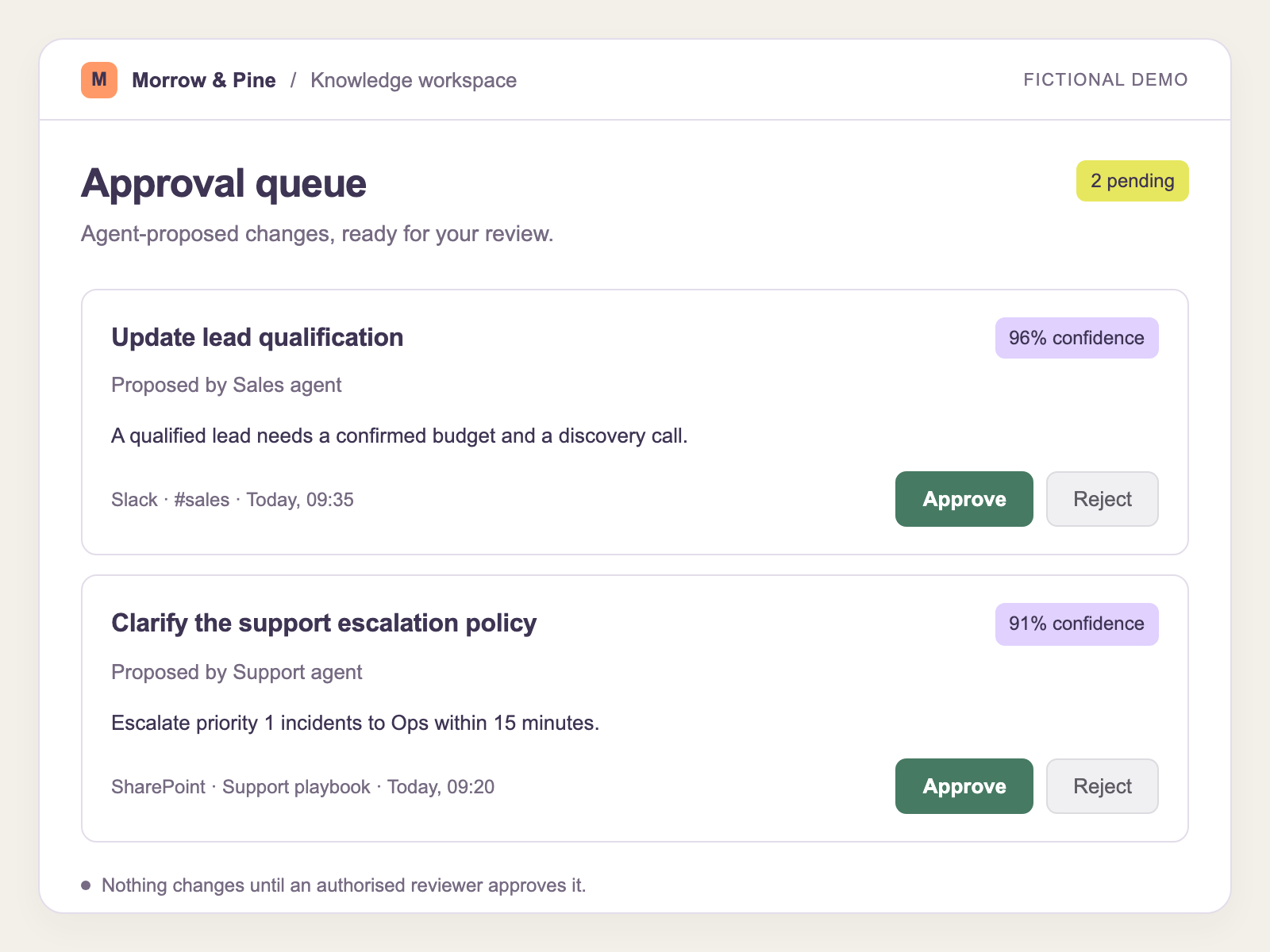
Knowledge that stays current
Vector databases don't learn. You re-index documents, sure. But that's a batch process. It doesn't capture what your sales team learned on a call yesterday or how your ops team redefined "SLA breach" last Tuesday.
Oiya captures knowledge continuously. Agent conversations surface new facts. Those facts become proposals with confidence scores. High-confidence, low-sensitivity updates get auto-approved. Everything else queues for human review. Your knowledge base evolves with your business, not against it.
RAG retrieves what was written. Oiya learns what was discovered.
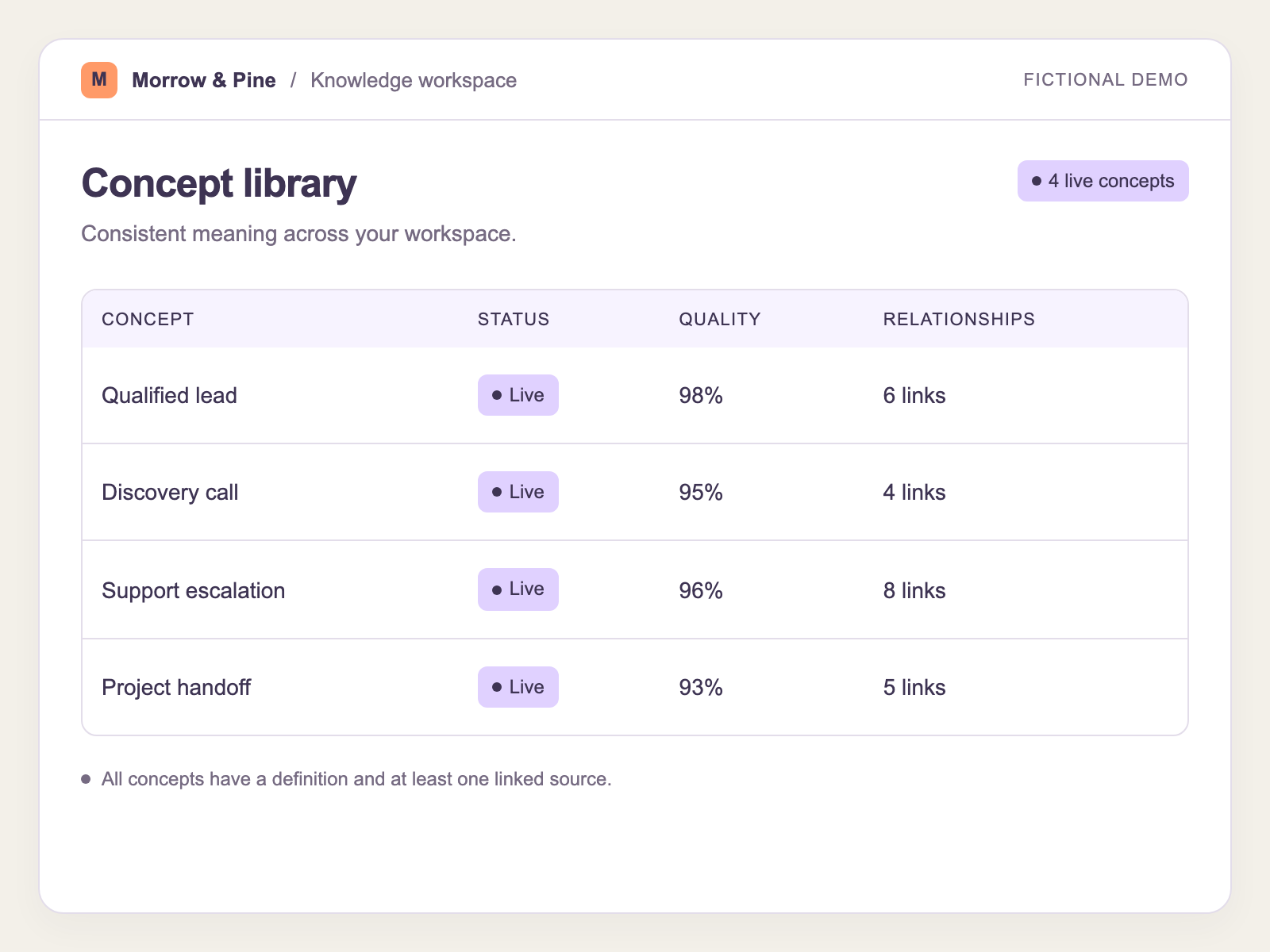
Structured concepts with definitions, relationships, and provenance, not chunks of text with similarity scores.
Ready to move beyond retrieval?
Give your agents real understanding, not just search results.
For the wider picture, read what a company knowledge layer for AI agents is and why multi-agent systems need one.
More comparisons
vs Knowledge Graphs
Knowledge graphs that learn and evolve.
vs Zep / Graphiti
From personal memory to company knowledge.
vs Mem0
Agent memory vs governed company knowledge.
vs Pinecone
Knowledge layer vs knowledge engine.
vs Knowledge Bases
Built for agents, not humans browsing wikis.
Knowledge Management
See the full knowledge management platform.
Product Overview
Understand the complete Oiya platform.