Product
The Agent Knowledge Base.
Oiya builds a shared, self-learning knowledge layer so every AI agent in your organisation stays on the same page.
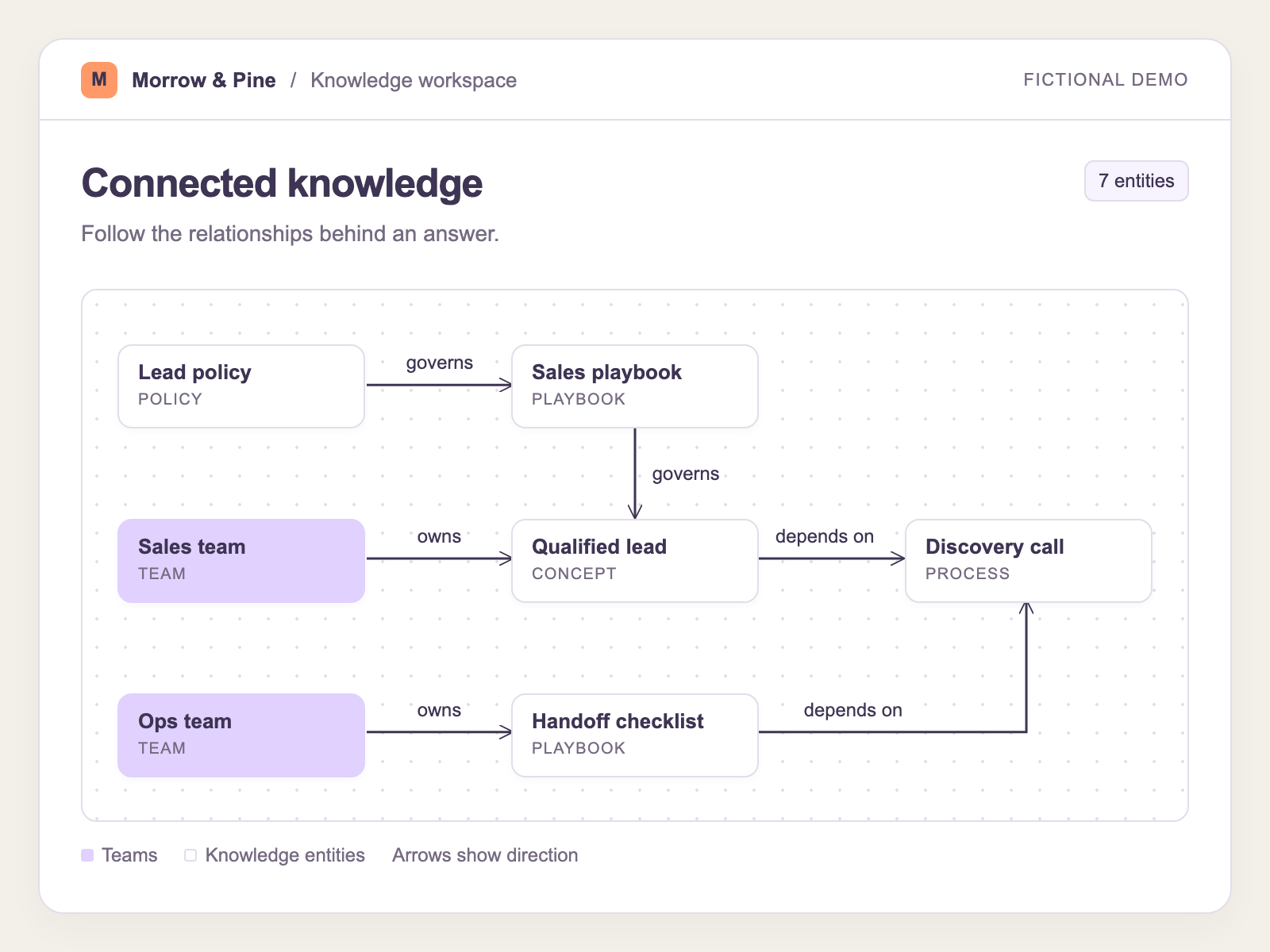
Oiya ingests data from sources a business already uses (Slack, Notion, file uploads, CRMs), structures it into a living knowledge layer, and exposes it to AI agents through standard tool APIs. The knowledge layer learns continuously: new information is organised automatically, emerging shared concepts are surfaced for human review, and every agent works from the same governed foundation. Underneath, that layer is represented as a governed knowledge graph: entities, relationships, definitions, workflows and approved changes that agents can query with the right permissions.
The platform
Four primitives. One structured layer.
Everything Oiya does sits on these four pieces working together.
Connect to your real sources of truth
Oiya integrates with Google Drive, Sheets, Jira, meeting transcripts, Confluence, Notion and more. Your data stays where it is. We read, index and structure it.
A structured ontology, not a vector dump
Rather than embedding text alone, Oiya extracts entities, definitions, relationships and workflows into a governed knowledge graph your agents can reason over. Think of it as a company-wide schema that evolves as your business does.
The learning loop
When agents take actions, they generate new context. Those learnings are captured as structured facts, reviewed by humans when sensitive, and promoted from team-level to company-level knowledge.
Versioning & controlled evolution
Knowledge and ontology can be versioned. Changes are tracked. You can roll back, compare and audit how your company's understanding has evolved over time.
Why teams use Oiya
Two ways into the same problem.
Whether you're building agents or running a team that uses them, Oiya solves real problems.
If you're building agents
If you're running a team
How it works
From connection to continuous learning, in four steps.
- 01
Connect your sources
Plug in Google Drive, Sheets, Jira, meeting transcripts, Confluence and more. Oiya reads your data where it lives. No migration, no copying.
Example: A consulting firm connects their shared Drive folders, project tracker in Jira, and weekly meeting transcripts. - 02
Oiya builds a structured ontology
We extract entities (people, projects, clients, processes), definitions, relationships and workflows into a queryable model. This isn't keyword search. It's structured understanding.
Example: Oiya maps out that "Project Atlas" involves 3 team members, 2 client contacts, uses the "discovery → proposal → delivery" workflow, and has 14 related documents. - 03
Agents query and use the knowledge
Your agents get structured, permission-aware context via API. They can ask questions like "who worked on similar projects?" or "what's our standard onboarding process?" and get grounded answers.
Example: A staffing agent queries past projects to recommend the best team. Based on track record, not guesswork. - 04
Proposed changes become approved knowledge
Agent actions generate new facts and proposed updates. Sensitive items go through human review. Approved knowledge is versioned and made available to other agents, so the layer improves over time without agents silently rewriting shared organisational truth.
Example: A BD agent discovers a new competitor positioning during research. That insight is flagged, reviewed by the strategy team, then approved as the new version of the competitive ontology available to other agents.
Control
Control where knowledge lives and who can use it.
Oiya keeps company knowledge separate from any single model or agent provider. Organisations can control how shared context is organised, which systems can access it and how proposed changes become approved knowledge.
Knowledge can be separated across teams, customers or operating environments, while reads, writes and approved changes remain traceable through a versioned history.
- Organise and separate knowledge across teams or customers
- Set clear boundaries around agent access
- Review proposed changes before they become shared context
- Maintain a history of versions, reads and writes
- Preserve company knowledge when models or frameworks change
Permissions & governance
Permissions built in.
Not everyone should see everything, and neither should agents. Oiya is built around spaces: team or department boundaries with scoped access. Agents contribute knowledge within their space. Useful concepts can be promoted upward when reviewed. Sensitive learnings stay contained.
Draft learnings vs. promoted knowledge, clearly separated
Review and approval for anything sensitive
Audit trails and source links
Dive deeper
Knowledge Management
Versioned, governed, observable memory infrastructure for your agents.
Multiplayer memory
Multiplayer memory so your agents remember together.
Data Fabric
A directory of your data sources so agents stop wandering.
Integrations
Connect to everything your team already uses.
vs RAG
RAG finds documents. Oiya understands your company.
vs Mem0
Agent memory vs governed company knowledge.
vs Pinecone
Knowledge layer vs knowledge engine.
For AI Engineers
Multiplayer memory with version control and scoped access.