How we compare
Your knowledge. Your infrastructure.
OpenAI Memory remembers your preferences. Oiya manages your company's knowledge, across every LLM, every framework, every agent.
OpenAI / ChatGPT memory
Per-end-user memory inside one provider. Useful for a single assistant, but doesn't transfer across models, frameworks or the rest of your stack.
Oiya
Provider-agnostic, organisation-wide knowledge. Switch models without losing context. Own the layer that every agent, yours or third-party, reads from.
OpenAI's memory feature gives a single assistant recall of past conversations. Oiya gives every agent in a company access to a shared, structured knowledge layer that evolves with the business, solving the multi-agent alignment problem, not just single-agent recall.
OpenAI memory vs Oiya, at a glance
Scope
OpenAI / ChatGPT memory
Oiya
What it remembers
OpenAI / ChatGPT memory
Oiya
Provider lock-in
OpenAI / ChatGPT memory
Oiya
Governance
OpenAI / ChatGPT memory
Oiya
Capacity
OpenAI / ChatGPT memory
Oiya
Primary use case
OpenAI / ChatGPT memory
Oiya
Platform memory is a trap.
OpenAI's memory is a neat feature. It remembers that you prefer bullet points, that you have a toddler who loves jellyfish, that you're vegetarian. It's limited to 100 saved memories per user and designed for personal assistant use cases. For that, it works well.
But here's the problem for companies building agent infrastructure: that memory is tied to OpenAI's platform. If you're also using Claude for code review, Gemini for data analysis, and an open-source model for internal tooling, each platform has its own memory silo. Knowledge doesn't transfer. Context doesn't compose. You're not building a knowledge layer; you're creating fragmentation.
And it gets worse. Anthropic is building memory. Google is building memory. Every provider is building their own walled garden. The more providers you adopt, the more fragmented your agents' understanding becomes.
One knowledge layer. Every provider.
Oiya sits outside any single LLM provider. It works with OpenAI, Anthropic, Google, Cerebras, and open-source models, whatever you're running today and whatever you'll switch to tomorrow. Your knowledge is stored in your infrastructure, accessible via API, and completely portable.
When you decide to move your support agent from GPT-4 to Claude, the agent's understanding of your company comes with it. No re-training. No re-ingesting. No starting from scratch.
Switch models, keep the knowledge.
Personal memory vs. company knowledge.
They sound similar. They solve entirely different problems.
Platform memory
Remembers individual user preferences across conversations within a single platform. "You like bullet points." "You're based in London." "You prefer Python over JavaScript." Limited to personal context: what you told ChatGPT stays in ChatGPT.
Scope: one user, one platform.
Company knowledge
Manages what your organisation knows: terminology, processes, relationships, policies, competitive intelligence. Structured, versioned, governed. Shared across every agent regardless of which LLM powers it. When one agent learns that Acme Corp just acquired a competitor, every agent knows.
Scope: every agent, every provider, one truth.
Works with every framework.
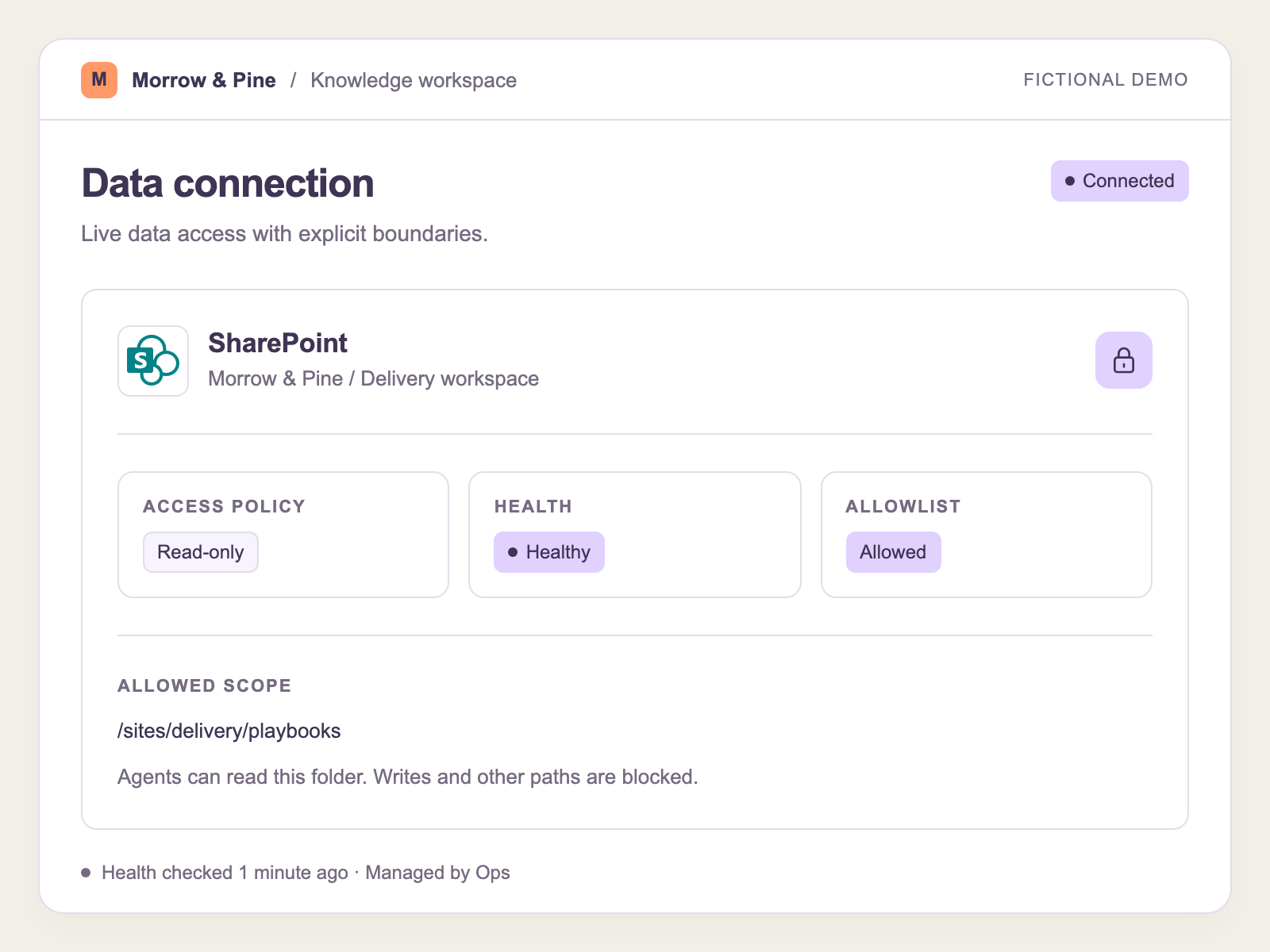
LangChain, CrewAI, OpenAI Agents SDK, LangGraph, custom builds: Oiya doesn't care how you build your agents. It provides a simple API that any agent can call to get structured context, propose new knowledge, and query the company graph.
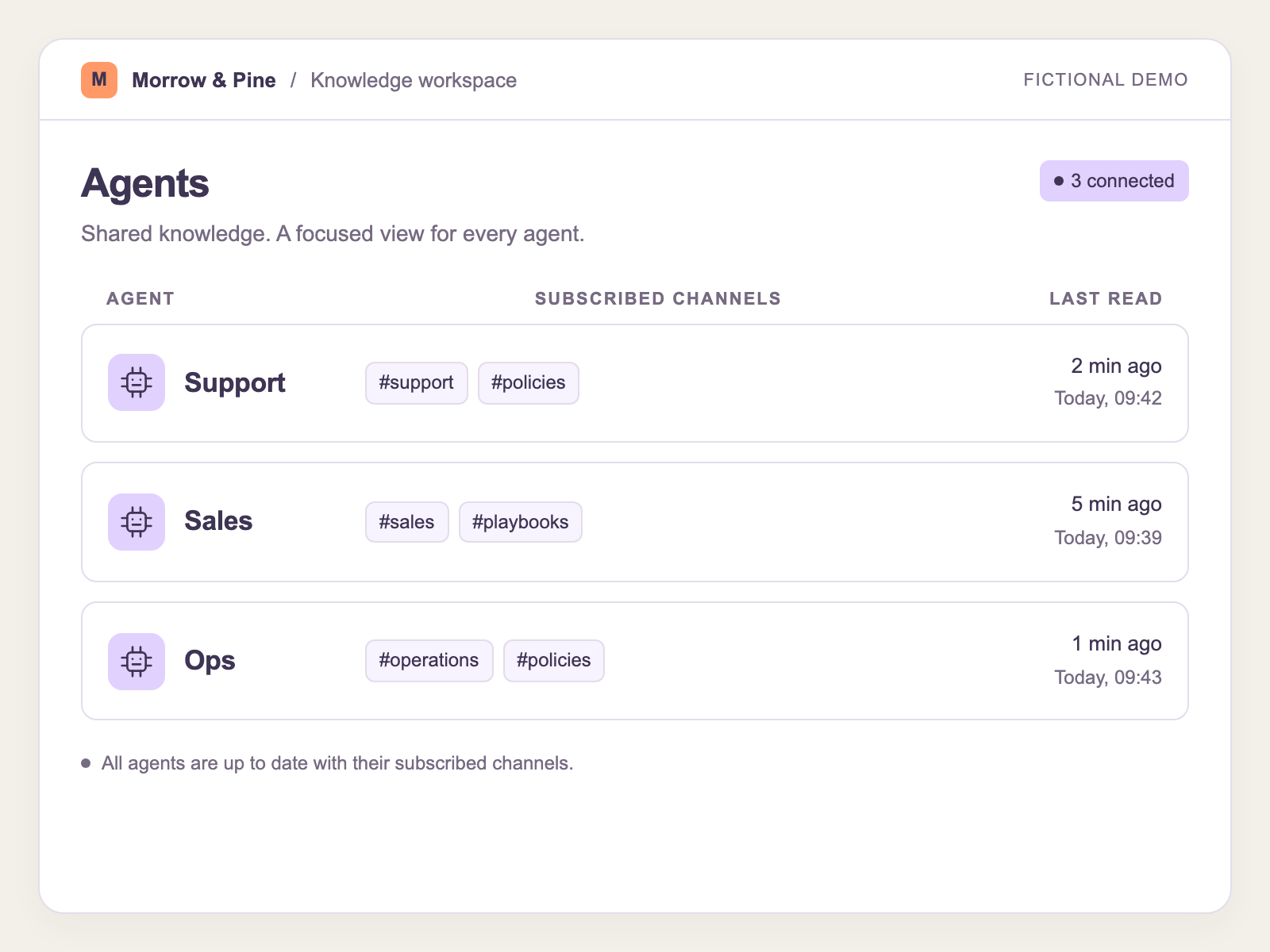
Each agent gets its own permission boundary. Your BD agent reads one partition. Your support copilot reads another. Your compliance agent has read-only access to everything. Permissions follow the agent, not the LLM provider.
A single pane of glass for agent knowledge management.
Stop building on rented memory.
Own your knowledge infrastructure. Work with any LLM. Switch providers without losing context.
For the wider picture, read what a company knowledge layer for AI agents is and why multi-agent systems need one.
More comparisons
vs RAG
RAG finds documents. Oiya understands your company.
vs Knowledge Graphs
Knowledge graphs that learn and evolve.
vs Zep / Graphiti
From personal memory to company knowledge.
vs Mem0
Agent memory vs governed company knowledge.
vs Per-agent memory
How Oiya sits alongside Mem0, Zep and Flumes.
vs Pinecone
Knowledge layer vs knowledge engine.
Product Overview
Understand the complete Oiya platform.